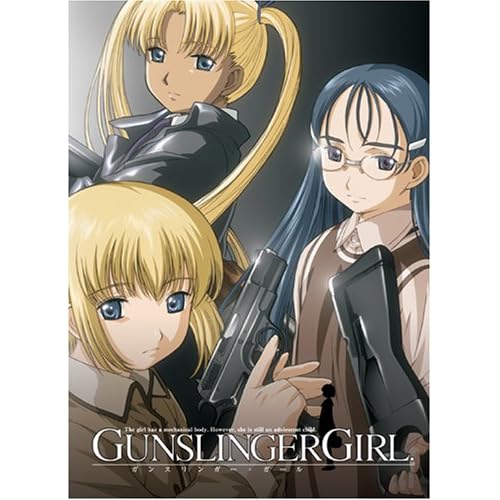
[Scroll to the bottom for a summarized "verdict", or read ahead for my full thoughts.]
DO NOT IGNORE THIS REVIEW JUST BECAUSE IT'S ABOUT ANIME!!!! Is that out of the way? Good. I'll have to have that rant some other time, but for now, all you need to know is that, unless you just hate animation in general, there is no excuse for dismissing anime just "because it's anime." View it as a medium, not a genre. That's what I do anyway.
Now, a few background bits to cover. First, I am not an anime nut, I just take the recommendations that come to me (see above). To me, the most important things in any series are the quality of the story and how well all the elements -- the story, the medium, the soundtrack, etc, etc. -- work together. And, to get on to this review's actual topic, Gunslinger Girl (hereafter GG) hits all the nails on their respective heads.
Now, I dismissed GG for a long time based on the name alone, despite my experience with (mis)judging books (and DVDs, and games...) by their covers. You see, I had seen clips of an anime a long time ago, wherein a blonde and a brunette in cowgirl-stripper outfits were running around in an improbable and over-stylized Old-West-meets-John-Woo shootout. Both characters had the kind of laughably massive breasts that should logically leave them totally immobilized, and what did they use them for? Reloading their revolvers, of course (use your imagination). While running along the saloon's walls. So in short, it was the kind of tired, boring, overly-stereotypical show that turned many of my peers off of all anime for good back in high school, and I just assumed, based on the name, that that was the show called Gunslinger Girl. How wrong I was.
I don't know what the literal translation of the Japanese title of GG is, but I know this: from time immemorial, American anime publishers and/or marketers have bought into the US's stereotypes about anime -- and the people who like it -- wholesale. I would be completely unsurprised to learn that this title was their idea. What sounds like a show about scantily-clad cowgirls pulling wire-fu stunts in between soaping each other up turned out to be a moving drama about children used as weapons in a very nearly contemporary setting.
Despite its title, GG belongs to a category that I call (in my own head, anyway) "anime noir." It's got little to do with American film noir, but I think of "dark anime" as being shows like Lady Death, Hellsing, Vampire Hunter D, or even Deathnote, that have elements of gothic, occult, and dark fantasy fiction in them. [Just to be up front, I have not actually watched any of the examples I just named; rather, I have come across clips, reviews, descriptions, etc.] These shows tend to be visually, tonally, and thematically dark, but focused around violence, damnation/redemption, the corruption/misuse of power, and other similarly grand and/or "loud" topics. To be clear: I don't think there is anything at all wrong with such an approach.
The works that I tend to think of as belonging to "anime noir," though, tend to be somewhat lower-key. I would include the sci-fi action/comedy Cowboy Bebop in this category despite its loud moments, irreverent tone, and futuristic setting because, at its core, Cowboy Bebop is an almost solemn character-driven tale, concerned more with the private hurts of its main cast than with the grand battle between good guys and bad. Over the course of its 26 episodes and 1 movie, Cowboy Bebop's protagonists do quite a bit of good (and bad!), but there's no saving the galaxy from evil, nor any overrunning of the universe by evil empires or hell-demons. Instead we follow our protagonists' trials and learn about them (and ourselves) along the way. Elfen Lied -- despite its soft-science premise, extreme violence, and misanthropy -- also falls into this category for similar reasons of tone, character, and focus. Yes, there is an amoral government agency doing unspeakable things in the pursuit of power; yes, there are high-powered mutants on the loose; and yes, the series is almost obsessively dark (in contrast to the art style). But for all of that, Elfen Lied is essentially about humanity and the lack thereof, and the different ways that its characters are affected by the evils they've suffered at the hands of everyday human beings.
So, to rope this discussion back on topic once again, Gunslinger Girl falls into this anime noir category for many of the same reasons. It has graphically violent gunfights, yes, but even these are depicted in terms of realistic tactical combat. It has sci-fi technology, yes, but it's presented as being astonishing to most of the characters, and also as being so imperfect that you wonder whether it's really worth using. And most of all, at its most basic, GG is a story about love, growing up, and how people relate to one another -- or fail to.
[As a quick note before I continue, I watched GG in Japanese with fan-translated subtitles, so I can't speak to the quality of English voice-acting.]
To expand upon my brief description a few paragraphs back: the Public Corporation for Social Welfare in near-future Italy is known to pay for the medical care of terminally ill patients, perhaps sometimes allowing experimental treatments. In reality, it is used to "recruit" soldiers into a government black-ops anti-terrorism organization. The story in the series follows the "soldiers" in Section 2 of the P.C.f.S.W.: young girls found dying in hospitals whose bodies have been mechanically/cybernetically enhanced. These child-operatives are each under the tutelage and command of an adult male (non-combat) operative, and these pairs are known as "Fratellos" (the English translation given in the fansub I watched was "Siblings").
Now, this description made me uneasy when I first read it, as it seemed to hint at pedophilia. Well, no worries on that front - the "sibling" descriptor is indicative of the kinds of familial relationships that these Fratellos have, including both healthy and dysfunctional relationships. The next obvious question is: why adolescent girls? The explanation given is that younger subjects are to only ones capable of successfully incorporating the mechanical bodies used by Section 2, and it is subtly implied that girls are easier to find, "adopt", train, and control than boys would be. So the premise does raise a few question marks, but it works surprisingly well in practice.
So then, what is it about GG that I like so much? The first thing that struck me is that the visual presentation and the sound design combine to give the whole show a rather lyrical quality. In addition to stunningly effective use of the Italy as a backdrop, the quality of the animation itself is generally good, if not jaw-dropping. Perhaps my only complaint about it is that it is obvious in a few places that they skimped on the dialogue-driven scenes in order to animate the action scenes more impressively, but really, the payoff is pretty well worth it.
Another high point is the deliberate, almost elegiac way in which the story unfolds. There really is no strong central conflict, and the show focuses instead on scenes that show us the characters and their strengths and struggles, as well as some illustrations of how something as unsettling as Section 2 happens. GG often gives the viewer multiple perspectives on a given event, including a "behind-the-scenes" look at the people bankrolling the operation - as well as opposing it. These additional shots can seem like unnecessary complications, especially since the cast is quite large, but in the end, they enhance the believability of the whole set-up, as well as the viewer's understanding. So the shifts in focus can be jarring or confusing at first, but it soon becomes apparent that the makers of GG know exactly what they are doing.
You've probably noticed by now that I haven't mentioned any individual characters yet. This is because the cast is very much an ensemble. The first Fratello we're introduced to -- Henrietta and Jose -- do serve as our emotional anchors as the story progresses, but there are at least 4 other central Fratellos, plus a multitude of supporting characters: scientists, bureaucrats, terrorists, legislators, and so on. The show's habit of introducing a new set of characters in one episode and basically finishing with them entirely in 26 minutes can be off-putting, but it means that they accomplish an astonishing amount of storytelling and character-building in 13 episodes.
I fear that if I go into anymore detail, I risk spoiling the pleasure of discovering the uncomfortably familiar world and movingly rendered characters of Gunslinger Girl for oneself. So without further ado:
THE VERDICT: Gunslinger Girl combines compelling character drama, deft storytelling, and outstanding artistry with bursts of real-world violence and flashes of insight into love, humanity, and growing up. The result is entertaining, affecting, and thought-provoking in all the best ways. Some of the storytelling and presentation techniques may frustrate a few viewers, but most audiences should find a lot to love about this moving anime saddled with a tragically misleading title.

