[Scroll to the bottom for a summarized "verdict", or read ahead for my full thoughts.]
If you liked Evanescence, you at least have a chance of liking After Forever on their 2007 self-titled album (which, I must confess, is the only one I've heard so far). Think of a numerical system of describing a rock band, where the full range of possible descriptors are given a score from 0 to 10. For example, Creed might have a 2 in Musical Complexity and Limp Bizkit might have a 0 in Lyrical Quality, but Green Day might get an 8 in catchiness. If you were to add 5 to all of Evanescence's scores, you'd have some idea of what this album sounds like.
In the most general of terms, After Forever is similar to any female-fronted, goth-and-metal-tinged rock band. On certain songs, you can almost hear them reaching for the poppy accessibility of mainstream rock and nu-metal, but it's almost like they can't bring themselves to do that to their music. The closest they ever come to the Evanescence mainstream is flirting with the sound of popular genre comrades Nightwish, though their sound always manages to remain distinct.
As my initial scoring-system description may have implied, After Forever plays pretty complicated music, but that's a little deceptive. They aren't like Opeth, with nary a song under 10 minutes and no recognizable structure to their songs. After Forever seems to start off by writing basic-but-solid symphonic metal songs, then spending lots of time dressing them up with an endless supply of progressive flourishes and nice touches. Even their most relentlessly driving songs -- "Transitory" comes to mind -- manage to incorporate rhythmic surprises and musical flourishes seemingly with each alternate step. These touches are mostly kept under control, though, and don't generally make the music overly busy.
Admittedly, I am a fan of a lot of busy music, but part of what I find appealing about After Forever is their lack of pretense. For all their drama (in addition to their inherently dramatic style, song titles include "Cry With a Smile," "Empty Memories," and "Dreamflight"), After Forever are surprisingly down-to-earth. Most of the songs on this album are fairly straightforwardly about relationships, romantic and perhaps otherwise, as opposed to other genre staples like fantastic creatures, epic adventures, or graveyard imagery. I personally have a weakness for all three of those more typical categories, and one could certainly point out that most recorded music deals with relationships in one way or another, but After Forever's approach struck me as honest, refreshing, and -- most importantly -- sincere.
If you've listened to any other music in the very broad category of "symphonic rock" -- heavy rock with at least string accompaniment -- what you've likely heard are nu-metal, black metal, or power metal songs with some orchestral flourishes to add atmosphere. If you've listened to Therion (one of my all-time favorite bands), on the other hand, you've heard a metal band essentially fitting seamlessly into an opera performance, often treating the the rock instruments as somewhat louder members of the larger orchestra. After Forever seems to take an opposite approach, using both live and synthesized symphonic instruments as though they were another guitarist or keyboard player. Lead vocalist Floor Jansen obviously has operatic training, but for the most part she sings plainly and completely in line with the mood of the song, avoiding the samey showboating that sometimes hamstrung former Nightwish singer Tarja Turunen.
On the subject of vocals, one thing worth noting is the occasional use of a growling male vocalist, which helps to place After Forever firmly in the metal camp to which they rightfully belong. I know several people who despise growled vocals, particularly when used to offset a beautiful female voice, but I think that After Forever's relatively sparing use of them helps to add punch to songs like the aforementioned "Transitory". After Forever are already treading a thin line between mainstream accessibility and metal cred, and the smart placement of the growls helps (in my opinion) to keep them from falling to one side or the other.
THE VERDICT: After Forever's self-titled album is an accomplished, focused symphonic metal product that has the potential to win over fans of Evanescence, In Flames, Cerberus, and most other bands on that continuum. Clever and creative use of genre elements like orchestral instruments and growled vocals help keep their sound intense while still maintaining this broad appeal. Highly recommended, and if you don't like the first track you sample, try another few before you write them off. As for me, I can't wait to delve further into their catalog!
 [Scroll to the bottom for a summarized "verdict", or read ahead for my full thoughts.]
If you've seen any of the Coen brothers' films, especially their older stuff, then you'll know exactly what you don't know is going to happen in their most recent effort, Burn After Reading. I have to confess that I haven't seen all of the Coens' films, only Blood Simple; Raising Arizona; Barton Fink; Fargo; The Big Lebowski; O Brother Where Art Thou?;The Man Who Wasn't There; and now Burn After Reading. Still, despite my incomplete viewing catalog, I expected every unexpected (and almost always unfortunate) twist of BAR's blackly humorous plot. That is to say, I had no idea what the details of the plot were going to be, but I was definitely not surprised by anything that took place on screen.
The previous Coen film that I was most reminded of was Fargo; BAR is more humorous and overtly satirical, but both indulge (perhaps to excess) in the Coens' trademark violent, bordering-on-absurd, darker-than-dark sense of humor. However, the brothers' stamp on this film is simply unmistakable, and if you've seen any of their films, you'll be able to see some similarities.
So it probably goes without saying that if you're a fan of the Coens' other work, you'll like this movie too. Then again, if you're a Coen Bros. fan, you've probably already seen BAR, so you're rather unlikely to be reading this. If you're going into this as your first Coen film, though, you should be warned: it is (like most of their other films) very dark.
The premise, as given by trailers and box summaries and the like, is that there is an ex-CIA analyst, Osbourne Cox (John Malkovich) who is writing his memoirs. These memoirs are found by two not-too-bright gym employees played by Brad Pitt and Frances McDormand, and they mistake them for intercepted intelligence. In pretty typical Coen brothers fashion, though, that's really only the coincidence that starts the plot rolling. Also pretty typically, the characters and plot twist and weave with little or no regard for viewer expectation, and things generally go from silly to bad to worse to worst for everyone. Not that I, watching the characters, particularly wanted happy endings from any of them.
None of that is to say, however, that I disliked the movie; quite the opposite, in fact. BAR was a very amusing, well-made film, but whether or not you should see it depends largely on how you feel about black comedy, and even about humanity in general. If you are prone to get depressed by misfortune or by despicable and/or ridiculous people, then you may want to give this one a pass. You see, some movies are downers but must be seen anyway because of the way they effect you, or because they're staggeringly powerful achievements, or they reach some fundamental truth of human life. But BAR is not one of those movies. It is well-made, to be sure; after all this time, the Coens certainly know what they're doing. The acting is very solid, so that you believe the characters without always seeing the high-profile actors portraying them. It's also entertaining, in the Coens' trademark way. It's even got solid social and political satire running through a lot of it. But it didn't have an effect on me in the same way as movies like Pan's Labyrinth, Princess Mononoke, Children of Men, Forrest Gump, or Amelie, to name a few.
My last critisim of Burn After Reading is that, like many of the Coen brothers' films that I've seen, I'm left wondering what the point of it all was. Some movies never make you ask the question at all (Spaceballs is obviously just supposed to be fun to watch, and it is), but for some reason, I always get to the end of a Coen film and wonder what they were trying to say. Perhaps its because I have a black humor threshhold, or because I generally look for some sort of emotional anchor in a story in order to really get into it, but Coen films are never entertaining enough to convince me that wry, witty fun is the whole point. So I cast about after the inevitable anticlimax in their films looking for some sort of theme, message, meaning, or thought, often in vain. Certainly, that was the case with BAR; the satire is unmistakable but vague, and slips into the background a lot, and I couldn't find anything to be learned from the characters or their stories.
So in the end...
THE VERDICT: I respect BAR more than I like it. The film is well-made, well-acted, clever, satirical, and entertaining, but the Coens' dark, near-nihilistic stamp is unmistakable, and in the end it felt kind of soulless. I'm glad I saw Burn After Reading, but I won't be buying it anytime soon.

[Scroll to the bottom for a summarized "verdict", or read ahead for my full thoughts.]
I'll begin by saying that I have always liked fantasy novels, even pretty cheesy ones. When I was growing up, anything with a dragon or a knight on the front was appealing, and wizards or witches were also a plus. These books are almost always written in a sensational, action-packed style ("...as pain burned through her body, Kaylira tightened her grip on her magic sword Gryphonizer, and heaved herself out of the rubble through sheer force of heroic will. The Bloodwitch cackled as dark energies danced around her claws..."), and generally feature an Ancient Evil, a Chosen One, a Beautiful-but-Dangerous Love Interest, and a Doom Prophecy. Some are stylistically more accomplished than others, some are even subtle and expressive, many turn into suspiciously lengthy series, but almost all are written in a very modern, straightforward style that brings to mind most readily a Hollywood film. Bookstore Sci-Fi/Fantasy shelves are packed with multitudes of such nearly-interchangeable Tolkein retreads, and I've always loved them.
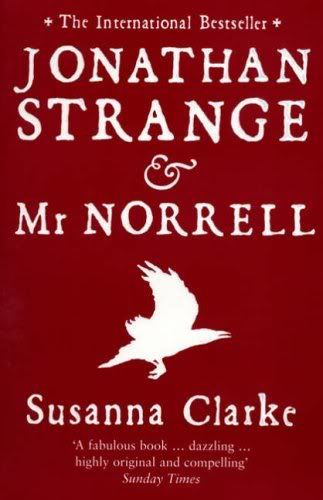
Yet wedged onto those same shelves is a misleadingly compact book by British writer Susanna Clarke. To me, it was the book's cover that immediately distinguished itself from its neighbors. Amid thousands of brightly colored, highly detailed, completely fantastical illustrations, this one boasted a nearly blank matte red cover with silvery lettering and a single embossed emblem of some kind of bird. I was intrigued enough to investigate, and I must say that I am glad that I did. As it turns out, this contrast of being in the Fantasy section but also apart from it is representative of many aspects of Jonathan Strange & Mr. Norrell.
Jonathan Strange & Mr. Norrell (hereafter JS&MN) appears to be of only slightly thicker-than-average paperback size, but is actually 1,006 pages long, and presented in unusually tiny typeface to boot. Not that this is an inherently bad thing. Across its considerable length, JS&MN is incredibly consistent in both style and quality. Whether the characters are having tea or rearranging the geography of Spain, the voice of the unidentified narrator remains satirically straight-faced, proper, superior, and credulous. The book is even littered with somewhat high-handed footnotes, many of which outline an entire fictional body of scholarship. There is definitely a lot of information to digest here, but it tends to be presented in such a way as to be both manageable and enjoyable.
As suggested above, the story covers quite a few scenes both exceedingly mundane and entirely fantastic, but to its credit, the everyday bits and the fantasy pieces are intermingled fairly well. The basic premise is this: In England during the Napoleonic Wars, a reclusive man named Mr. Norrell comes forward as a "practical magician" (as opposed to a "theoretical magician") and offers to use his magic to aid the British war effort on the Continent. Not long after, a younger, more outgoing man named Jonathan Strange discovers a talent for practical magic, and it isn't long before he apprentices himself to Mr. Norrell. (There's obviously a lot more to it than that, but I don't want to give too much away.) Built atop this foundation is a tale that mixes dry, tongue-in-cheek satire of Victorian England with old-time fairy tale fantasy.
I can't stress the "old-time" part of that description enough; this isn't going to remind anyone of a Disney fairy tale. This is much more in the vein of the original Little Mermaid, where she turns into seafoam at the end, the version of Cinderella that involves peoples' feet being sliced up, and Hansel and Gretel where the witch is going to cook the children but gets cooked herself. Basically, this is an understanding of fantasy that has no place for Tinkerbell, fairy godparents, or kindly dwarves, and it makes the story all the more interesting. Which is fortunate, considering that, like the Victorian novels it emulates, the plot develops very slowly, often in episodes.
Perhaps it's just because I'm such a fan of Tad Williams' series, in which plots spin out over thousands of pages yet pretty much every detail along the way contributes to the denouement, but many of the individual scenes in JS&MN seem pretty extraneous. Some characters are included and developed early on, and then are simply never revisited after a while. Some things are purely extra, others eventually come back, and still others contribute in much smaller ways than I expected. While all of this does give the book a very strong, singular voice that successfully echoes both the early novel and old European fairy tales and adventure stories, it also made it very hard for me to get into.
Usually when I like a book, I don't just read it, I devour it, losing myself in the story and the need to know how it turns out. Previously, a difficult writing style has occasionally slowed me down some, but this is the first time I've encountered a book in which the plot itself just won't let me all the way in. The formal style, the arrangement of the numerous minor events in the story, and even the chapter breaks and perspective shifts in JS&MN seem deliberately calculated to keep the pace of the story well below "stately" for the majority of the book. Every time I was really getting into a particular sequence, I was jarred out of the experience in one manner or another, and as a result I picked it up and put it down an awful lot.The payoff when the story reaches its climax is breathtaking, but my raves about it are subdued quite a bit because the process of getting to it is so inexplicably laborious. To put it another way, reading this book is a lot like canoeing down an extremely sedate river for days, until you become convinced that you're actually on an unusually long, narrow lake, only to find yourself suddenly plunging over a beautiful 300-foot waterfall.
In the end, despite my tepid enthusiasm, I have to give Jonathan Strange and Mr. Norrell a strong recommendation. It is interesting, original, very stylistically accomplished, and can be enjoyed on a number of levels by any reader with the patience to get into it. Though it borrows heavily from two relatively well-known traditions, I doubt you'll encounter anything else quite like Susanna Clarke's debut novel.
THE VERDICT: Jonathan Strange & Mr. Norrell would probably be equally at home on a shelf next to Northanger Abbey or next to Sword of Truth books, and fans of either will likely find something to enjoy about this very original, interesting read. Just don't expect to finish it in a flash, and don't be surprised if it proves a little hard to get into. Definitely recommended.